


Fluentis ERP: Advanced Technology
Fill out the form to request information
Technology is the
cornerstone of Fluentis ERP
Continuous innovation and “Continuous Development” are the foundation of the Fluentis philosophy, acting as a guarantee for the future in an ever-evolving landscape. This enables businesses to stay aligned with the trends of “Digital Transformation” and seize the opportunities it offers.
With the arrival of our latest release, our platform takes another leap forward in terms of scalability and cloud nativeity.
SOA Technology:
Service Oriented Architecture
The software is built on careful architectural design.
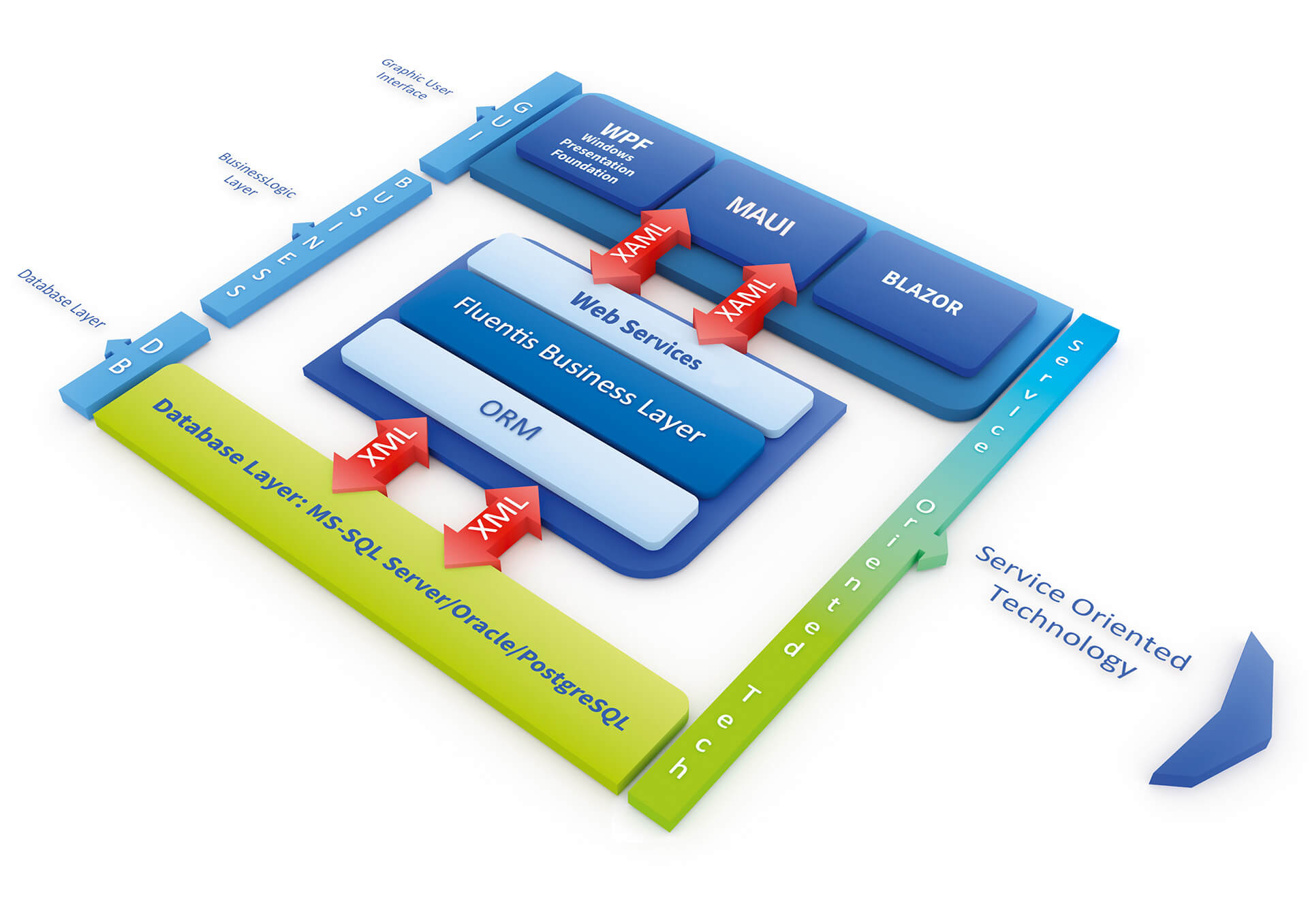
The reference paradigm is the SOA (Service-Oriented Architecture) model, with the underlying technology based on the Microsoft environment.
Full Object Oriented
Fluentis is built around a large library of business objects that represent a vast data set, consisting of approximately 3,000 tables and 30,000 fields, all properly linked to meet a broad range of business needs and application content.
The application is considered Fully Object-Oriented because the object library doesn’t just represent the structural data of tables. Each object is designed to represent specific business entities in detail.
For example, an object can represent Customers, Suppliers, Inventory Items, documents like Orders or Invoices, etc. Each object can be either Read-Only, meaning it can only expose the relevant information, or Read-Write, meaning it can expose methods and functions that allow interaction with the application’s algorithms.
This object library is the sole communication channel to interact with the entire business management environment. It frees the partner (Integrator) from needing to understand complex tabular and procedural organizations used to extract, process, and analyze information within the system.
An additional benefit is the ease of extending each object. Customizing entities to meet specific business requirements is a common task for the partner or power user.
Database Abstraction (ORM)
Fluentis has been carefully designed, including its database access layer.
There is no direct access to the database; instead, it is handled through an Object-Relational Mapping (ORM) layer. Each object is mapped to a database table, either in a One-to-One or Many-to-One relationship.
In fact, a single table can represent multiple objects simultaneously. For example, a single “Contacts” table can represent the Contact, Customer, and Supplier objects at the same time.
The role of the ORM layer is to route all requests for querying, inserting, updating, and deleting data between the database and the application library, relieving the developer from creating complex and often error-prone SQL queries.
Additionally, the ORM is capable of generating database-specific queries based on the DBMS used, taking into account the specific dialects and the version of the SQL engine currently installed.
User Interface Independent (Web API)
The Fluentis GUI has been designed to operate in a SOA (Service-Oriented Architecture) environment, enabling both User-to-Machine and Machine-to-Machine communication. This ensures that any interface can be functional. The standard interface is developed using XAML (Extensible Application Markup Language), making it accessible in various formats: WPF (Windows Presentation Foundation), web browsers, and mobile environments using Xamarin.
Additionally, by creating interfaces in HTML5 format, the library can be used to access non-Microsoft platforms such as Mac and Linux.
Browser Client (BLAZOR)
Fluentis is also available in browser mode (including for Mac), allowing users to work in sync across different devices and environments, while utilizing the most appropriate user experience.
A browser-based web application offers several advantages, as it is accessible from a wide range of devices, including desktop computers, laptops, tablets, and smartphones.
All you need is a simple web browser to access the application: this enables users to connect from anywhere without requiring additional software installation, promoting real-time collaboration and information sharing.
Additionally, updates and maintenance are simplified thanks to the centralized distribution of changes.
.NET 10:
Multi-Platform Approach
The Fluentis codebase is powered by the most modern software technologies on the market.
The platform has completed its transition to the .NET 10 framework, ensuring companies achieve maximum performance, next-generation native security, and total versatility.
It is Open Source
Unlike the .NET Framework, this makes it a platform more open to support and evolution.
It is Modular
This makes it lighter, easily scalable, and adaptable to the needs of the solutions you want to implement.
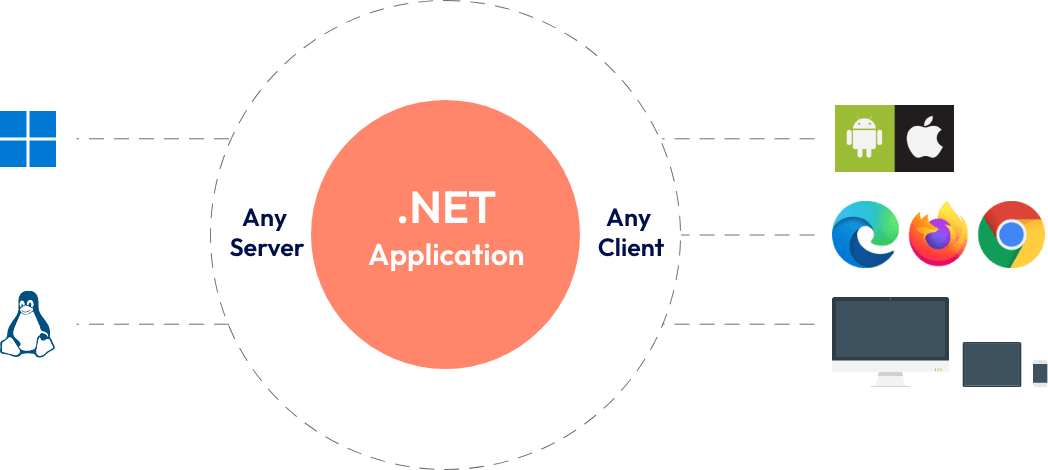
It is Cross-Platform
It allows operation in both Microsoft and Linux environments.
It is Versatile
It natively supports container management via Docker and focuses on developing WPF, Web, and Mobile solutions.
Why .Net 10?
.NET is the benchmark open-source development platform created by Microsoft with a native cross-platform approach, ideal for building desktop, web, and mobile applications across multiple operating systems.
The decision to align the F2025 release with the .NET 10 specifications is driven by the framework’s seamless unification across Windows, Linux, macOS, iOS, and Android. This enables true, uninterrupted Cross-Platform operations, delivering unprecedented stability in handling the most demanding business processes.
Cross-Platform Server:
The "Windows" or "Linux" dilemma? Better not to have to choose
On the server side, Fluentis eliminates the need for being tied to a Microsoft-only environment, allowing server configurations that are adaptable to any customer’s needs and internal expertise.
With Fluentis ERP, it’s possible to operate on both Windows and Linux without needing to recompile the solution. The different platforms can be combined, enabling hybrid solutions, such as a Linux web server interfacing with a Microsoft database management server, or vice versa.
This feature opens up significant opportunities for redesigning the infrastructure required to run the system, offering a measurable competitive advantage.
Installing Fluentis on Linux servers allows you to:
Reduce Licensing Costs
Since Linux is an open-source operating system, there are no licensing fees involved.
Lower Hardware Requirements
With the same installation size, Linux uses significantly fewer resources compared to Windows.
Minimize System Maintenance Effort
Setting up and maintaining a Linux environment takes much less time and resources than a Windows-based system, making it easier to manage and keep up to date.
Enhance Scalability and Performance
Linux machines are lighter and can be quickly deployed when needed, allowing for better scalability and faster performance.
Benefits for
the Client
Cost-effective: Linux does not require licensing fees.
Secure: Linux is less prone to viruses and malware.
User-friendly: While Windows offers a more intuitive user experience.
Lightweight: Linux is a less resource-heavy and more lightweight system.
Open Source: Linux is an open-source platform, providing flexibility and customization options.
Benefits for
the Partner
Extend expertise in Linux.
Ability to offer solutions on both platforms.
Greater flexibility in configuring the solution for the end customer. For example, an Active Directory server in Windows, SQL in Linux, and Business Layer in Linux. All options are possible.
Ability to choose the most suitable Linux distribution.
Cross Platform Client:
Usable Interface in Different Modes
To meet the modern needs of end users, who often require dynamic access to the application from various workstations and devices, Fluentis offers maximum flexibility by enabling the development of a centralized interface that can be accessed in different ways.

It is possible to leverage shared models and view models across the three platforms, differentiating only the graphical interface design for the desktop, mobile, and web versions.
Desktop Version
Based on a WPF workstation, installed on client PCs as a rich client application.
Mobile Version
Based on an app developed in Maui, making it accessible on all mobile devices such as tablets and smartphones.
Web Version
Built with Blazor, allowing the application to be accessed via browsers, including from Apple devices.
Cross-Platform Database:
"MS SQL Server," but not only
Database Architecture: Native Optimization on MS SQL Server and Architectural Flexibility
Fluentis ERP bases its efficiency and stability on Microsoft SQL Server, the native benchmark and standard DBMS for all current deployments, selected to ensure maximum reliability, market reach, and performance in enterprise environments.
Thanks to its proprietary abstraction layer (ORM), the Fluentis architecture is inherently designed to be database-engine independent. This means the system is structurally engineered at the R&D level to interface with different SQL dialects (such as PostgreSQL or Oracle) in special scenarios or for future roadmap developments.
Benefits for
the Client
Native Integration
Fluentis ERP fully leverages the power and security of Microsoft SQL Server, the market-leading DBMS renowned for its reliability and widespread adoption across enterprises.
Performance and Continuity
An optimized architecture that ensures smooth transactions, eliminates bottlenecks, and guarantees the absolute integrity of corporate data.
Superior User Experience
It leverages a widely adopted system that is simple to manage and perfectly aligned with modern corporate IT infrastructures.
Benefits for
the Partner
High dynamism.
Ability to offer highly professional solutions.
Capable of meeting the needs of both on-premises and cloud environments.
Opportunity to retain technical expertise in related technological fields.
Balance between costs and performance.
Scalability with Containers:
maximize processing power when you need it.
Scalability is the ability of a system to increase its performance based on the available or allocated resources.
With container technology, Fluentis ERP allows for efficient scaling of algorithms.

With Fluentis, you can create computational environments in seconds, tailored to your current needs.
We’ve moved from physical servers to virtual ones, and now with Containers, we’ve further improved resource allocation for individual container instances. This advancement also enhances update speed and scalability of environments.
What is Docker?
Docker is a platform that enables the rapid creation, testing, and deployment of applications. It organizes software into standardized units called containers, which package everything needed for the application to run efficiently and reliably.
How Does Docker Work?
Docker functions as an operating system for containers. Just as a virtual machine virtualizes hardware, containers virtualize a server’s operating system. Docker simplifies container management by providing straightforward commands to create, deploy, and operate containers efficiently.
Why Use Docker?
- Faster Software Deployment
Accelerates release cycles and minimizes the impact of updates, reducing costs related to resources and customer downtime. - Standardization and Simplification
Streamlines release processes, making it easier to deploy, identify issues, and perform rollbacks for system restoration. - Simplified Application Creation and Scaling
Enhances deployment speed by enabling the creation of standardized environments and eliminating conflicts between versions and technology stacks.
Benefits for
the Client
Access to variable performance levels over time.
Flexibility to utilize only the resources actually needed.
Increased computing power without excessive investment.
Ability to allocate processing capacity to specific algorithms.
Benefits for
the Partner
Avoid hardware bottlenecks (vertical scaling) where performance improvements are tied to significant hardware investments.
Leverage horizontal scalability, enabling multiple containers or VMs on the same hardware to boost performance.
Deploy additional pools or containers to enhance system power and capacity.
Contact us for more information
Get in touch with us if you:
- Are a SMB in Manufacturing, Distribution, or Services
- Need to streamline and digitalize your business processes
- Want to take advantage of the benefits of a native cloud solution
- Want to replace your non-integrated softwares with a unified ERP platform
+1 281 404 1726
Chat with us